
Sommerbris 2026: a festival workforce in full swing
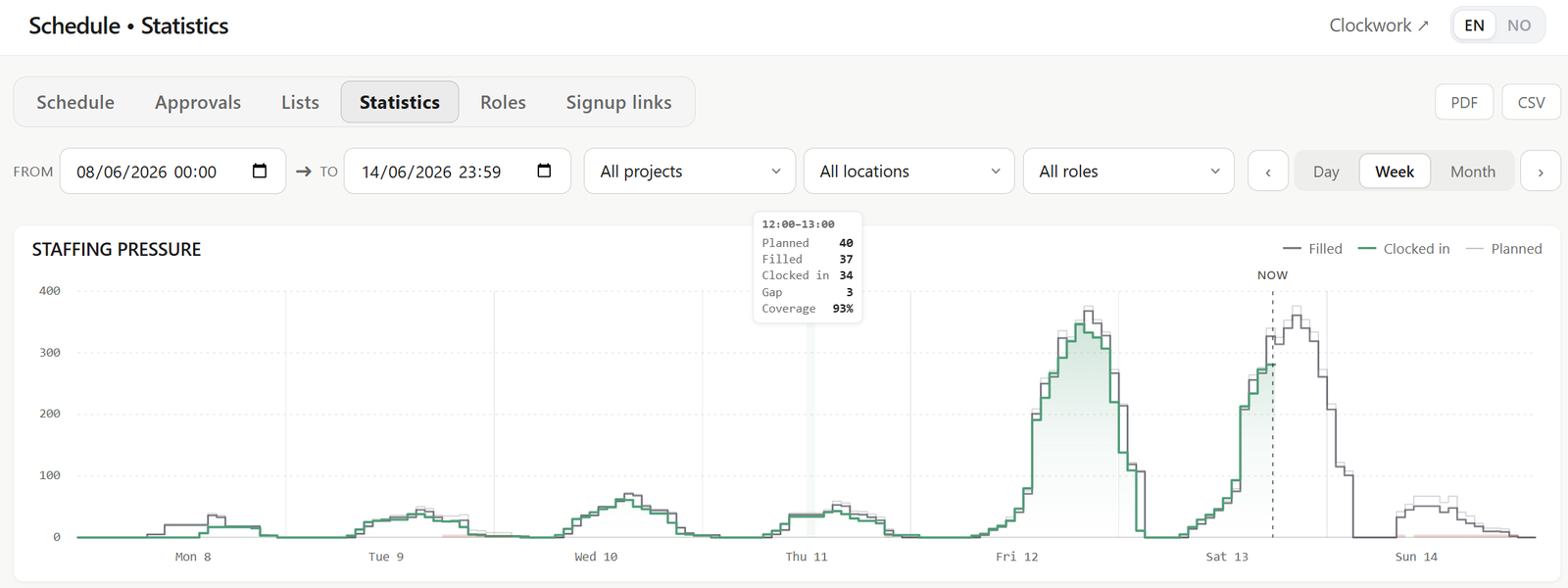
More than 1,000 crew clocked in across the build-up, festival days and dismantling. The production planned 1,328 shifts, and on the Saturday evening 416 were clocked in at the same time.
The festival
Sommerbris is a music festival on Odderøya in Kristiansand. The 2026 edition, its fifth, ran on 12 and 13 June.
Its crew is mostly temporary: festival workers, dugnad teams (volunteer crews from local clubs and associations), supplier crews and a small production team. Most work a few shifts a year, and nearly all of them arrive in the same few days.
Published 12 October 2026. Describes HR Cluster as it was used for the June 2026 festival.
Shifts planned and filled cover 3 to 16 June: the build-up, festival days and dismantling. Filled is the final schedule. Crew clocked in counts the different people who clocked in on the project in June. 416 is the Workforce dashboard's live value on the evening of Saturday 13 June.
About this case study: HR Cluster was developed alongside live productions. Its founder is part of the production management team for Sommerbris.
The challenge
A festival schedule is not hard to draw. It is hard to keep true.
Hundreds of people, most of them working a few shifts a year, arrive in the same few days. Shifts start before everyone is in place. People turn up without a shift. Sessions run long.
On the night, the production needs three answers at once. Who is here? Where are we short? What do we fix first? Afterwards, every hour has to be right before it reaches payroll.
How HR Cluster was used
A schedule for the whole crew
The production planned 1,328 shifts across the build-up, festival days and dismantling. In the final schedule, 883 crew filled 1,230 of them, and 162 more clocked in without a planned shift. About half of the assignments were made by hand and the rest imported in bulk.
Shifts by period: 289 from 3 to 11 June, 849 on the festival days (12–13 June) and 190 from 14 to 16 June.
The 47 dugnad teams, 665 people, each had their own group, so a team's list and its shifts sat together.
A small test in April let crew pick open shifts themselves on a public sign-up link. Almost every assignment was still made by the production.
Saturday evening, live
On Saturday 13 June the dashboard showed 416 people clocked in. 304 of them were working a planned shift, and shift coverage at that moment stood at 86%: the share of the planned headcount on the shifts then running that was covered by crew clocked in.
A staffing chart put planned, filled and clocked-in numbers on one timeline, two hours back and eighteen ahead. The evening and the night still to come were on one screen.
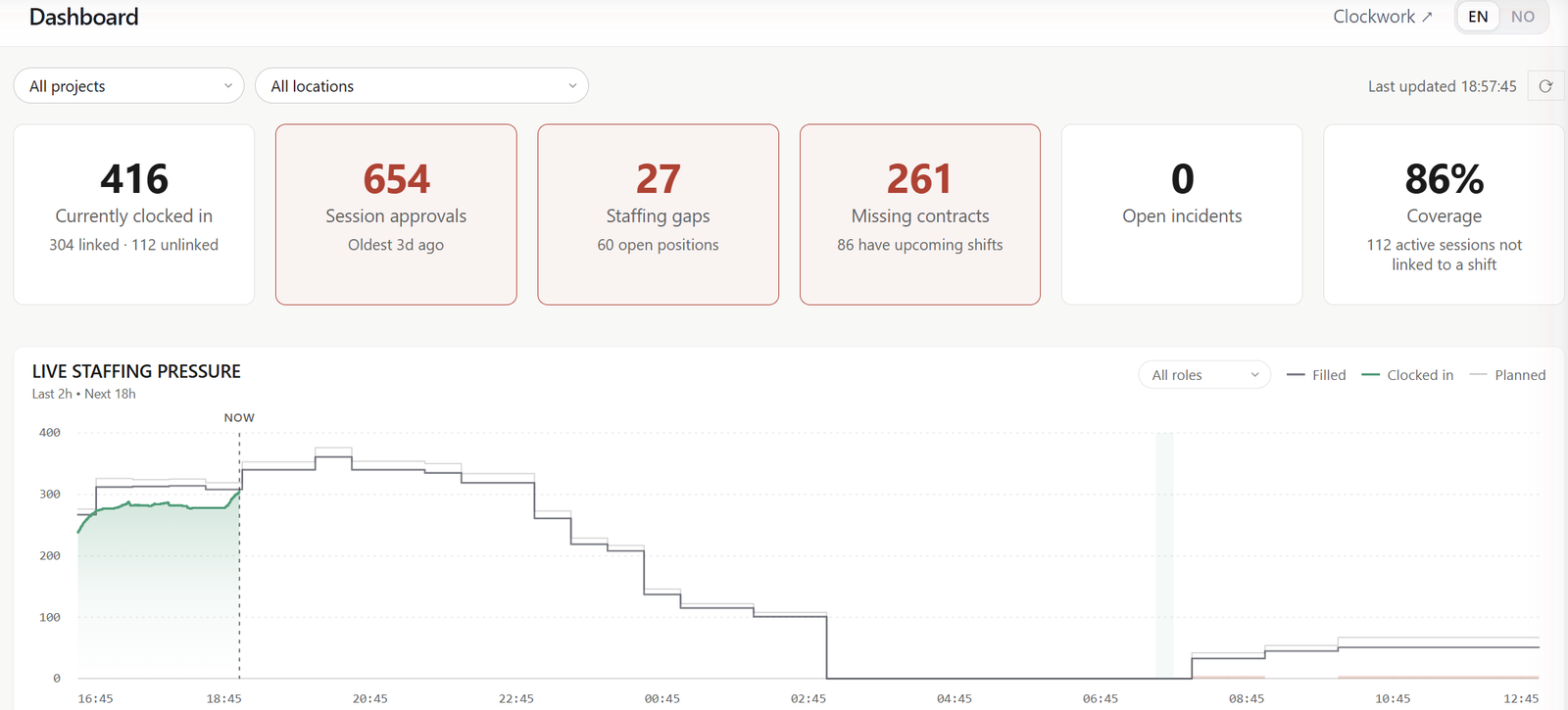
The same screen kept the follow-up work in view: sessions waiting for a manager's approval, open shifts, and people with shifts ahead but no signed contract.
Most of the crew clocked in with a personal QR code, scanned on arrival. Management used the PIN terminal. HR Cluster linked each session to the person's planned shift when there was one.
HR Cluster gathered the exceptions in lists of their own, so the production could follow up clock-ins without a shift, shifts short of staff and sessions running past their planned end.
Radios and other equipment were issued to named people, with 90 items out that evening.
Fixing the record while it is fresh
At this scale, some clock-outs are always missed and some times are wrong.
HR Cluster lets a manager correct a session while the original times stay on record alongside the correction, and holds sessions for approval before they can be exported to payroll.
Before the festival: registration and contracts
Festival workers registered through HR Cluster's own forms and sign-up links. Depending on how a form was set up, a submission created the person or waited for a manager's approval, and placed them in a team.
Allergies and certificates went on the same profile.
Employment and dugnad agreements were generated from the festival's templates and signed online, or uploaded as signed copies when signed elsewhere. By the Saturday, 850 contracts were signed, and the dashboard listed anyone without a signed contract who had shifts coming up.
Crew and production in one workspace
The production side ran in the same workspace. On 13 June it held 470 accreditation records, typed for the build and the festival days, and 55 risk assessments, alongside the festival's vehicle, supplier and power records.
What the production gained
On the busiest evening, the production could see in one place how many people were working, how that matched the plan and where coverage was thin.
We have not measured time saved against earlier years, and we don't publish an estimate.
Later additions, such as the production plan, shift sign-up for crew logged in to their own page, contracts that list a person's shifts and a minimum rest rule between shifts, are described on the product pages.